A 6-year-old finds Nebraska's first conulariid fossil in 55 years
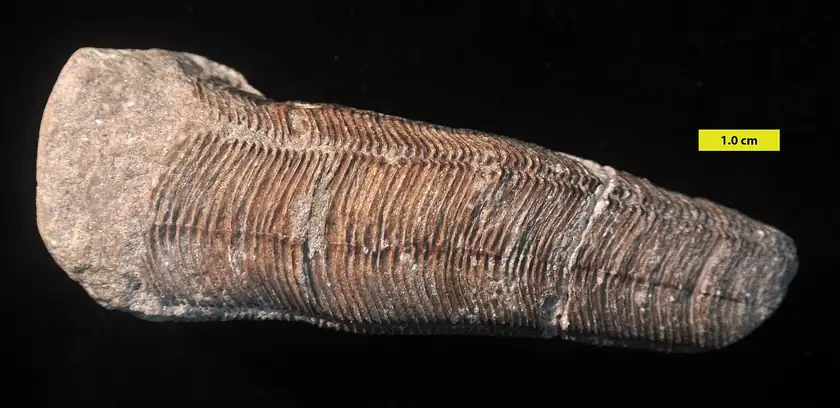
Leo Youngdahl spotted a 2.75-inch imprint of the ancient jellyfish-like animal at Schramm Park and let it stay there for education programs.

Read the original
The reporting lives at The Nebraska Courier. Our summary is checked against it, and we link it on every story.
Leo Youngdahl, 6, found a conulariid while turning rocks at Schramm Park State Recreation Area, The Nebraska Courier reported. He had been searching for crinoids, the sea-lily fossils common in eastern Nebraska. The rock he flipped held a 2.75-inch herringbone imprint. Kelly Ekue, outdoor education specialist at the Schramm Education Center, did not recognize it among the six fossils the park usually sees. Experts she contacted identified a conulariid, described as a jellyfish-like animal shaped like an upside-down pyramid, which lived between 200 million and 500 million years ago.
The last known Nebraska specimens were found 55 years ago, across the Platte at Louisville and Weeping Water. Youngdahl left this one at the park for education programs. The outcrop is bedrock about 350 million years old, from when a saltwater sea covered Nebraska. Ekue asks visitors to bring a camera, leave picks and hammers at home, and stay out from under overhanging rock. Most finds there are smaller than a penny.
For the classroom
Leo Youngdahl is 6. He was looking for crinoid fossils, sometimes called sea lilies, in the rocks at Schramm Park State Recreation Area near Gretna, Nebraska. He turned over a rock and found a herringbone pattern 2.75 inches long. He took it to Kelly Ekue at the park's education center. She did not know it, so she sent photos to experts. They said it was a conulariid, an ocean animal that lived 200 to 500 million years ago and looked a bit like a jellyfish shaped as an upside-down pyramid. Nobody had reported one in Nebraska for 55 years. Leo agreed to leave the fossil at the park so other kids can see it in class. He is still hoping to find a whole crinoid.
- What was Leo looking for, and what did he find instead?
- Why did he leave the fossil at the park instead of taking it home?
- What rule should a visitor follow when they hunt for fossils at a park?
For a teacher to read with a class. Print the story of the day · All classroom stories
More good news
Other stories in the same neighborhood of kindness.
 Science
Satellite leak-hunting saves rural New Mexico an estimated 327 million gallons a year
In its first year, the state's LeakTracer program found 216 leaks across 28 small utilities. Officials want to take the satellite search statewide.
Verified · Santa Fe New Mexican Science
Upper Teesdale's rare alpine plants get three years of seed funding
A local trust received £65,000 to collect seed from arctic-alpine plants and put it back on the fells with volunteers.
Verified · BBC Science
Pupils in Cemaes talked with an astronaut whose school badge flew on the space station
Ysgol Cemaes met NASA astronaut Frank Rubio by video on October 21. A badge the Anglesey school designed earlier this year was already aboard the International Space Station.
Verified · BBC News