Baniwa fishers share the Içana River with giant otters
On a river where fish are scarce, most of the Baniwa fishers interviewed do not treat otters as rivals. They move, wait, or quiet the boat, and many call the otters guardians of the water.

Read the original
The reporting lives at Mongabay. Our summary is checked against it, and we link it on every story.
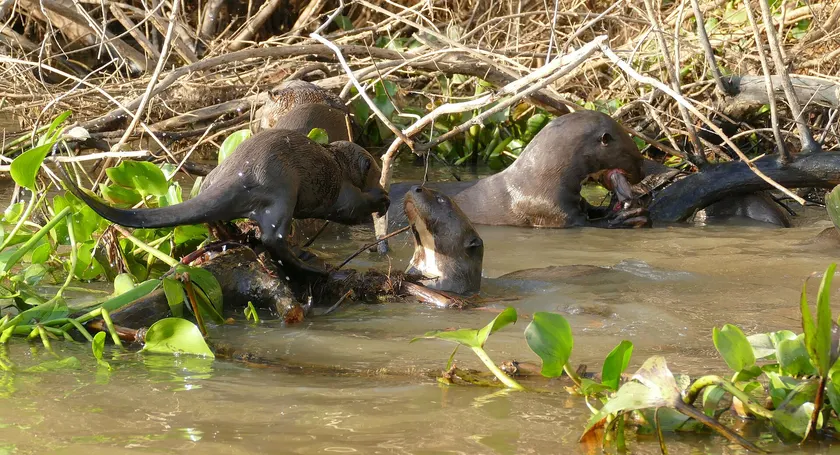
On the Içana River in Brazil's upper Rio Negro, Baniwa fishers and giant otters hunt the same dark water, and most of the fishers do not try to drive the otters off. Mongabay reported on October 29, 2026, on a study led by ecologist Natalia Camps Pimenta. She and her colleagues interviewed 19 fishers in seven communities along the middle Içana, inside the Upper Rio Negro Indigenous Land. In the dry season, 84 percent said they regularly meet otters while fishing. Only 32 percent described them as competitors. Nearly two thirds said they change spots, wait for the otters to leave, or quiet the boat.
The diets only partly overlap. People favor medium and large fish. Giant otters and neotropical otters eat mostly smaller ones. Giant otters often use shallow streams and tend to retreat from paddles and engines. Groups run to about nine to twelve animals. For many Baniwa, the giant otter is a pajé of the waters, a guardian whose presence means fish are there and looked after. A fisherman in Tucumã Rupitá told researchers the otters belong to that place. An elders' creation account, published in 2017 and cited by Mongabay, puts otters among the beings who ran into the river and became its shamans.
The relationship was broken and then rebuilt. In the 1950s and 1960s a commercial fur trade paid hunters for skins, and giant otters collapsed across the Amazon, including here. Brazil's 1967 fauna law and, later, the demarcation of Indigenous land in the 1990s helped the animals return. Elders linked the otters' absence with fewer fish, and their return with fish coming back. Pimenta said coexistence here is not only a belief. It is also history, rules, and the habit of using a scarce river in a way that leaves room. The study is those 19 interviews and that history. It is not a new count of otters on the Içana.
For the classroom
Giant otters and people both catch fish in the Içana River, in the Amazon in Brazil. Mongabay reported on October 29, 2026, that Baniwa fishers usually let the otters be. Researchers talked with 19 fishers in seven communities. Most of them see otters while they fish in the dry season. Only about a third called the otters competitors. Nearly two thirds said they move to another spot, wait, or make less noise. Many Baniwa people call giant otters the shamans of the water, guardians that mean fish are there. The otters mostly eat smaller fish than the people do. A fisher from Tucumã Rupitá said the otters belong to that place. The study is about how these communities share a river where fish are not plentiful.
- What do the fishers do when they meet otters on the river?
- Why might eating different sizes of fish make sharing easier?
- What is a wild animal that lives near people where you live, and how do people make room for it?
For a teacher to read with a class. Print the story of the day · Morning announcements · All classroom stories · This week's Good News Friday pack
Tucumã Rupitá, BrazilIndigenous communitiesWildlife conservationRiversGood news on October 29
More good news
Other stories in the same neighborhood of kindness.
 Science
Regrowing tropical forests shaded out many non-native trees
Across 1,561 plots in ten Neotropical countries, exotic trees were common in the first decades and then lost ground as the canopy closed.
Verified · Phys.org Animals
Alcatrazes marked ten years as a wildlife refuge
A decade after the archipelago off São Paulo became a federal refuge, monitors say sharks are showing up again. Night fishing is still a problem.
Verified · Folha de S.Paulo Community
An Ōtara teacher wrote rugby league books to get kids reading
David Riley's new series follows players and the Samoan and Tongan teams. A librarian told him three boys slipped into the library early so they could borrow the books first.
Verified · RNZ