A fossil crocodile from Cairo's limestone is a species of its own
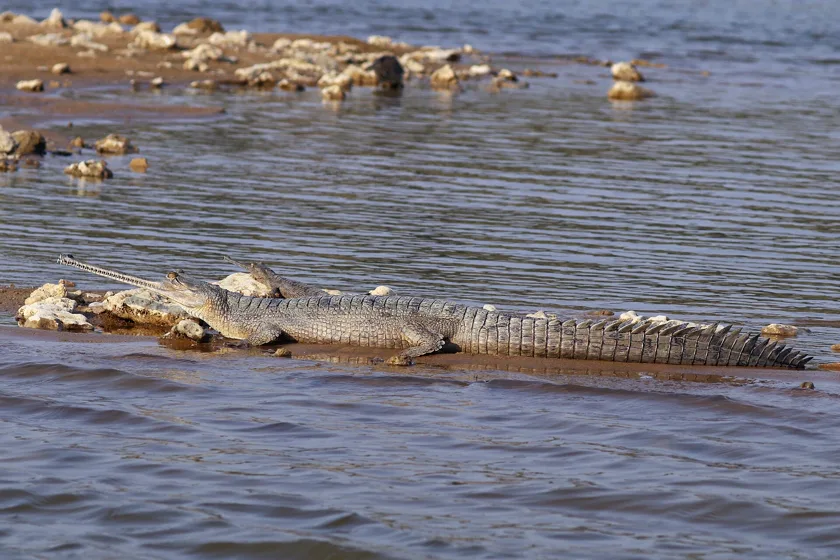
Researchers renamed a 45-million-year-old gavial from the same rock as the Great Sphinx after CT scans showed it was not the false gharial it had been called.

Read the original
The reporting lives at Smithsonian Magazine. Our summary is checked against it, and we link it on every story.
A crocodile skull collected near Cairo in the 1920s has been given its own genus. Smithsonian Magazine reported on October 9, 2026, on a paper published two days earlier in Royal Society Open Science.
The fossil came from the Mokattam Formation east of Cairo, a marine limestone about 45 million years old. That is the same stone the Great Sphinx and the pyramids at Giza were carved from. The skull, about 18 inches long, is missing the tip of its snout. The Sphinx is missing the tip of its nose. The team, including researchers in Britain, Sweden, Germany, and Egypt, named the animal Herugavialis cairensis, after Heru, the god also known as Horus, whom some texts link to the Sphinx.
For decades the bones were filed under Tomistoma, the false gharial. Micro-CT scans found differences, including telescoped, raised orbits. It was a gavial, a fish-eater with a long thin snout, and it did not cluster with the living false gharial or with some other fossil gavials from the Mediterranean. Co-author Philip Mannion, of University College London, said the shared stone and the missing nose made the name feel right. The paper revises a label on a museum skull. It does not add a living animal to the Nile.
For the classroom
Smithsonian Magazine reported on October 9, 2026, that scientists studied an old crocodile skull found near Cairo about 100 years ago. The rock it came from is the same kind of limestone that was carved into the Great Sphinx. The skull is about 45 million years old, and the tip of its snout is missing, a little like the Sphinx missing the tip of its nose. For a long time people thought the fossil belonged with the false gharial. New scans showed it is different. The team named it Herugavialis cairensis, after an Egyptian god also called Horus. It was a fish-eating crocodile with a long thin snout.
- How can a scan of an old skull tell scientists it is a new kind of animal?
- Why did the researchers connect this fossil with the Sphinx?
- What is a gharial, and how is its snout different from other crocodiles?
For a teacher to read with a class. Print the story of the day · All classroom stories
More good news
Other stories in the same neighborhood of kindness.
 Science
Iowa engineering students built a custom game controller
Biomedical engineering students at the University of Iowa built Dylan Huntbach a Nintendo Switch controller with oversized buttons and joysticks he can use after a spinal cord injury.
Verified · University of Iowa College of Engineering Science
Colorado State uses AI to warn of hail hours earlier
NSF-backed researchers at Colorado State, working with NVIDIA, built models that look for hail sooner: about two to three hours with Hail-StormScope, and one to eight days with CSU-MLP.
Verified · Colorado State University Science
Northwestern physicists hold one antimatter particle for months
Gerald Gabrielse's team cooled a single positron nearly to absolute zero and suspended it for months in a trap with no walls, a step toward a sharper matter-antimatter comparison.
Verified · Northwestern Now