Researchers released Oregon monarchs wearing solar-powered tags
At Blue Heron Park in Phoenix, Oregon, a crowd watched 22 tagged butterflies lift off on a migration people can follow by phone.

Read the original
The reporting lives at Jefferson Public Radio. Our summary is checked against it, and we link it on every story.
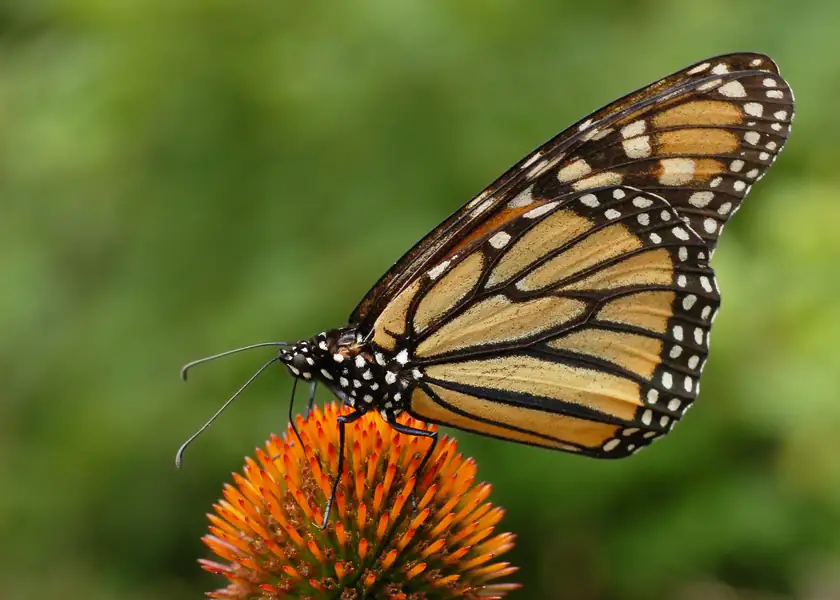
Kids and adults gathered at Blue Heron Park in Phoenix, Oregon, to watch monarch butterflies leave with tiny solar tags on their backs. Jefferson Public Radio reported on September 29, 2026, that Washington State University entomologist David James fitted 22 butterflies that morning, September 17. The transmitters, made by Cellular Tracking Technologies, weigh 60 milligrams, about a tenth of an adult monarch's weight, and phones can pick up the signal through the Project Monarch app.
The tags are already drawing a route. One butterfly released in Elkton was detected a day later about 95 miles away, near Gold Beach. Robert Coffan of Southern Oregon Monarch Advocates called that hop a record for the project. James had also tagged monarchs this year in Portland, Bend, Brookings, Ashland, and Klamath Falls, and about 100 more were released in Idaho earlier in the month. Roughly 200 people helped pay for the tags by adopting a butterfly.
For the classroom
At Blue Heron Park in Phoenix, Oregon, children and adults watched 22 monarch butterflies lift off wearing tiny solar tags. The tags weigh 60 milligrams, about a tenth of an adult monarch's weight, and a phone app can pick up the signal. One butterfly released in another Oregon town was detected a day later about 95 miles away, near the coast. A scientist had also tagged monarchs this year in several other Oregon cities, and about 100 more were released in Idaho. Roughly 200 people helped pay for the tags by adopting a butterfly. The tags draw a route people can follow.
- Why would scientists want to know where a monarch flies?
- How can a tag that small stay on a butterfly?
- What is one thing a garden can offer a monarch?
For a teacher to read with a class. Print the story of the day · Morning announcements · All classroom stories
Science in OregonPhoenix, OregonPollinatorsWildlife conservationKidsGood news on September 29
More good news
Other stories in the same neighborhood of kindness.
 Science
Caldera High students turned leftover pumpkins into compost
At a Pumpkin Smash, Bend residents dropped off Halloween pumpkins. The load went to a commercial composting facility instead of the landfill, and organizers hope to repeat it.
Verified · Central Oregon Daily News Science
Chinook salmon returned to 88% of their old Klamath habitat after the dams came down
After four Klamath River dams were removed in 2024, sonar counts recorded 7,742 Chinook passing the former dam sites that fall and more than 13,000 in 2025. The fish spread through 214 miles blocked for about a century.
Verified · Mongabay Science
A passenger rode a pilotless air taxi on a short flight in Kai
Euronews reported a 380-metre demonstration on November 20 at an academy runway in Yamanashi. A later uncrewed lap covered about 1,800 metres. Commercial service is not approved.
Verified · Euronews