A study says small gold rings may have marked long-distance traders in Mesoamerica
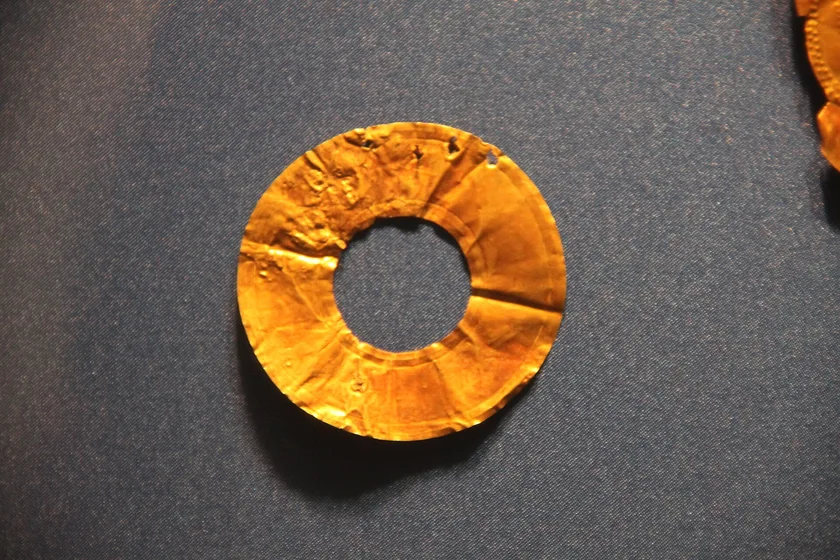
Phys.org reported that an archaeologist at El Colegio de Michoacán grouped copper and gold-colored face rings found from Mexico to El Salvador and read them as a trader's badge, not as proof.

Read the original
The reporting lives at Phys.org. Our summary is checked against it, and we link it on every story.
A handful of small metal rings, easy to miss beside the bells and needles of Mesoamerican sites, may have been how a long-distance trader showed who he was. Phys.org reported on November 26, 2026, on a study in the journal Ancient Mesoamerica by Laura Solar-Valverde, an archaeologist at El Colegio de Michoacán in Zamora.
Metalworking spread into western Mexico from Central and South America around the year 900. Among the bells, needles, earrings, and fishhooks, some sites also held a ring: a face with a long nose and a two-lobed feathered headdress. Solar-Valverde reads that face as Yacatecuhtli or Ek Chuah, gods of trade in Aztec and Maya tradition. The rings turn up from the hills of Hidalgo to the coast of Belize, the Pacific shore of Guatemala, and the borderlands of El Salvador. They are small, about 1.8 to 2.5 centimetres across, sized for an adult finger. One from Cerro del Teúl was still on a buried person's hand. Sites that have them usually have only one or two, while bells and needles show up by the dozen. The same places also held goods from far away, including Plumbate pottery, stone vessels, turquoise, shell, and other metal.
Sixteenth-century accounts say traders carried several marks, including rings, and then stop. They do not describe the rings. Solar-Valverde's point is that people who have been inferred from the goods they moved can be pictured as individuals. The link to merchants is an argument from the look of the rings, where they were found, and those brief texts. It is not a label that was still attached to every ring.
For the classroom
Phys.org reported on November 26, 2026, that an archaeologist in Mexico has an idea about some very small rings. Laura Solar-Valverde, at El Colegio de Michoacán in Zamora, studied rings found from central Mexico to Belize, Guatemala, and El Salvador. Most show a face with a long nose and a feathered headdress, like gods of trade. The rings fit a fingertip, and sites usually have only one or two. One was still on a person's finger at Cerro del Teúl. Old writings say traders wore rings, but they do not describe them. The match is a suggestion, not proof.
- How could a small piece of jewelry tell strangers who a traveler was?
- Which of these places is closest to where you live: Mexico, Belize, or El Salvador?
For a teacher to read with a class. Print the story of the day · Morning announcements · All classroom stories · This week's Good News Friday pack
More good news
Other stories in the same neighborhood of kindness.
 Science
Puerto Madero students brought their turtle project back to the Mazatán museum
Diario del Soconusco reported that Cobach students from Puerto Madero continued research at the regional turtle museum and that the paper credits them with a national prize.
Verified · Diario del Soconusco Community
A Xochimilco farming network won a €100,000 prize for the chinampas
Mongabay reported that Lucio Usobiaga and Arca Tierra received the Basque Culinary World Prize for work with chinampa farmers, including biofilters meant to help axolotls.
Verified · Mongabay Animals
Two gray foxes rescued near Tepic recovered and went back to the woods
El Mañana reported that Profepa released two young gray foxes in a Nayarit forest after they were found sick near Tepic on October 16.
Verified · El Mañana